
Life of Unfoldment
As the soul unfolds its nature, we no longer view life at a distance. We know one existence, eternal, infinite and free. In absolute Oneness, there is neither near nor far. There is no separation. Being and becoming have no distinction.
As the soul unfolds its nature,
we no longer view life at a distance.
We know one existence,
eternal, infinite and free.
In absolute Oneness,
there is neither near nor far.
There is no separation.
Being and becoming
have no distinction.
All are parts of one Reality,
indwelling and all-pervasive.
Learn to unfold
the divine blessings of soul
at each stage of life.
Know the spiritual value of every experience.
Practice living the life of yoga
with sincere determination.
This discipline becomes
a source of boundless joy.

Ahimsa: Highest Dharma
In the Gita, Krishna revealed that denial of the Self is himsa or injury. Buddha, the enlightened one, taught that ahimsa is the highest dharma (principle) of life. Patanjali was a mystic and philosopher of ancient India. He offered thoughtful insights and enlightened commentary on yoga and suggested the practice of yama or the discipline of abstention from injurious thought, word or deed.
Patience, humility, tolerance, understanding, respect: these are the qualities of ahimsa. There are tactics, strategies and movements that people have collectively utilized to encourage a nonviolent basis for society. However, the foundation of ahimsa begins with a charitable thought, a kind word or an act of service toward another human being. When our very nature revolves around such an existence, there is no doubt in our mind as to how to approach a difficult situation or how to resolve a conflict, because we have already fortified our heart and mind to be flexible, creative and fearless. We have the strength to endure. We are not controlled by anger. Rather, we constructively direct our energy and find enough strength of character to realize a higher calling than the ugliness and brutishness that could otherwise pull us down. Any action which is adversarial or coercive in motive is contrary to the philosophy of ahimsa. The desire to do good, to be charitable and to contribute to the well-being of all comes only through pure love. Such love is not just a preference for some familiar persons or conditions to others. It is the awareness that all life is one and interrelated, progressing from one source to one goal.
The practice of ahimsa is as broad as life itself. It consists of our daily efforts to convert the negative demands of our selfish ego into the positive expressions of the soul. This requires constant attention, subtle thinking and above all, great love. Pure and sincere efforts are the greatest powers and attainments of ahimsa.
What Gandhiji comprehended, advocated and lived, is a complete yoga of love. Love is the hub of the wheel. The idea of returning love and forgiveness for hatred and injury was not, of course, invented by Gandhiji. It is as “old as the hills.” In the Gita, Krishna revealed that denial of the Self is himsa or injury. Buddha, the enlightened one, taught that ahimsa is the highest dharma (principle) of life. Patanjali was a mystic and philosopher of ancient India. He offered thoughtful insights and enlightened commentary on yoga and suggested the practice of yama or the discipline of abstention from injurious thought, word or deed. Gandhiji himself referred often to the teachings of Christ to “Love thy neighbor as thyself…resist not evil…and bless them that curse you, do good to them that hate you, and pray for them that despitefully use you and persecute you.” Such unconditional love is true bhakti, complete dedication to the spiritual ideal of absolute oneness.
Srimati Karuna
Gandhi’s Steadfast Yoga

Perfecting the Means
Perfecting the means is a constant effort that requires steadfastness and humility. It requires placing importance upon every thought, every word and every deed. Our actions produce effects in both seen and unseen ways. Therefore, we should not be attached to the ends for we may not know or understand the actual effect.
Perfecting the means is a constant effort that requires steadfastness and humility. It requires placing importance upon every thought, every word and every deed. Our actions produce effects in both seen and unseen ways. Therefore, we should not be attached to the ends for we may not know or understand the actual effect.
It can be a great challenge to maintain our equilibrium when we are faced with difficult circumstances. We recognize the difference when an action is done in anger, impatience or intolerance, versus when our action is performed in joy, sincerity or selflessness. We think we know what will be the outcome, but we don’t have control over it. In fact, we barely have control over our own thoughts, let alone our words and actions. As difficult as it is to control our thoughts, it is impossible to have control over the results of our actions. The best we can do is employ appropriate means. We know every cause has an effect, yet we don’t know all the conditions and circumstances at play. Why should we be attached to the results or fruits of our actions? The life of yoga is freedom from such attachment.
The Bhagavad Gita implores us not to worry over the results of action. An action is a given cause. When the cause is given, its effect is inevitable. Therefore, good actions bring forth good results. We recognize this in the biblical expression, “the good tree bringeth forth good fruit.” Performance of good work brings only good to the world. If we have given out a good cause, a good result is bound to come. All negative actions produce inharmonious results. Then why worry over the result of an action? Worry is destructive. By worrying over the result of a good action, we destroy to a certain extent the good result that the given cause might have produced. But this does not mean that we must be unthoughtful about the result of our action. Before we engage, we must, to the best of our ability, find out what result our action is going to produce. Then when the action is done, we should not worry over the result.
When we work with pure concentration, completely immersed in our work, losing ourselves within the Self, we inevitably produce a noble result. Karma Yoga is constant self-remembrance in the performance of action. Our actions not only affect our own individual life, but they also influence the lives of others. There is a reverberation effect. It is like a boomerang that is sent out and returns to us. Our actions touch us as well as everyone around us.
Srimati Karuna
Gandhi’s Steadfast Yoga
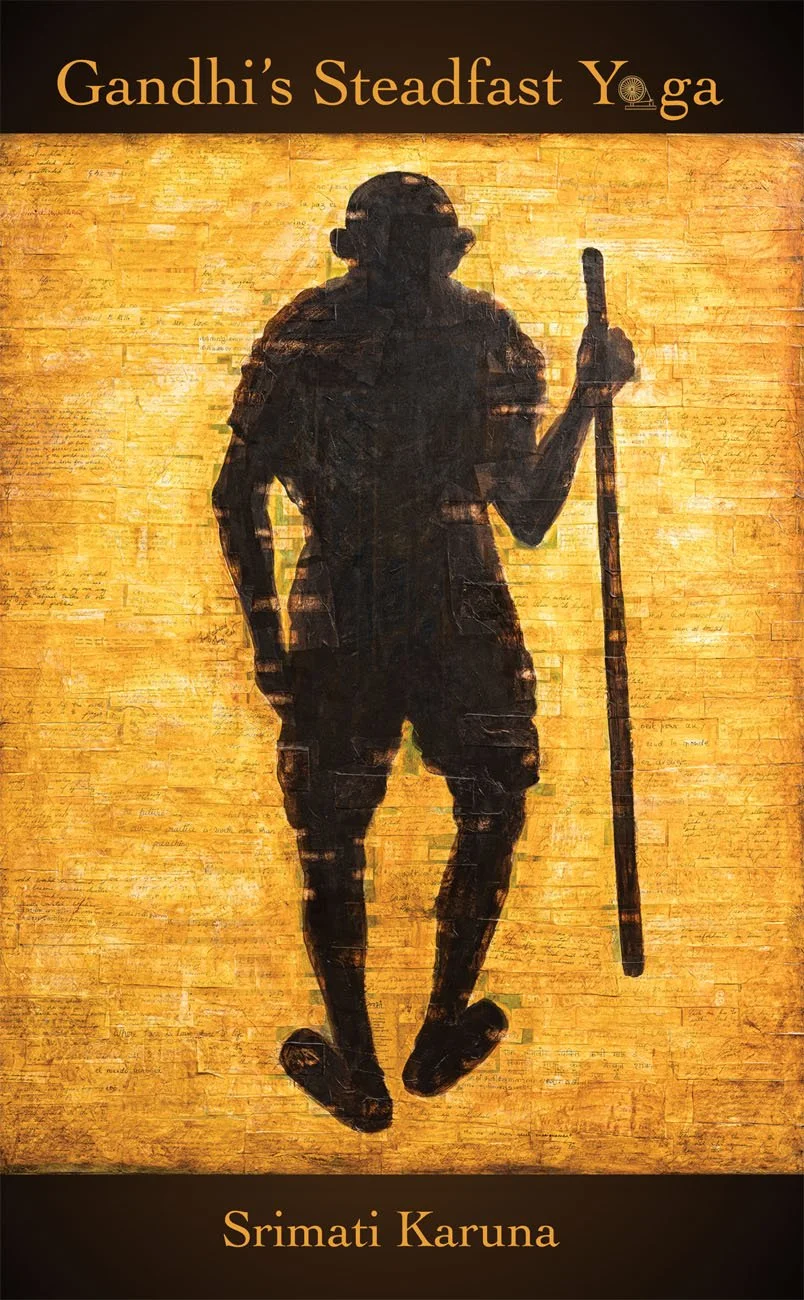
The Wisdom of Jnana Yoga
Wisdom is the discerning nature of the soul. It is not merely intellect but a higher state of consciousness that guides us internally. Self-knowledge has a value unequal to any other possession in life. It is that which alone reveals the true nature of ourselves and the world around us.
Jnana Yoga is the path of wisdom. In the perfection of knowledge we overcome maya, or the illusion of the unreal. The unreal has no existence, or at least, it is transitory in nature. The Real can never cease to be. Constantly engaged in the world of objective thought impressions, we become entangled in what is considered the web of maya. By wisdom we transcend maya. By the revelation of our true nature, we disentangle ourselves from the web of confusion. We are then able to think and act with discernment.
Jnana Yoga is the yoga of knowledge, not knowledge in the intellectual sense but that of pure consciousness. It is that knowledge that is inseparable from the true experience of Reality. A person who can see through the multitude of physical forms and worldly attachments, sees through the illusion of maya and can concentrate the mind on what is Real. In the purity of mind we establish the light of truth in our life. The desire for wisdom is innate within us.
The motto of the Gujarat Vidyapith, the university established by Mahatma Gandhi in Ahmedabad, India in 1920, stresses that knowledge is that which liberates us: Sa Vidya Ya Mukte Ye. These words can be found engraved on the wall of the university and on its seal.
Freedom is attained in the knowledge of the Self. Attainment of self-knowledge requires self-mastery, self-discipline and constant practice. It is, in essence, what Gandhiji meant by swaraj. Commonly, we learn of the movement for India’s independence as swaraj. But to Gandhiji, it personally meant more than the self-rule of a nation or home-rule for India. In his mind, swaraj meant rule of the self or individual self-mastery, leading to self-realization. Swaraj over this little self involves practicing self-control by putting aside limitations in the form of biases and prejudices, impatience and intolerance. We want to move beyond the chitta or mind stuff that keeps us from understanding the true nature of the soul within us and all beings. We want to be free of that which binds and limits us. Gandhiji referred to swaraj as the key ingredient on the path of wisdom. The Jnana Yogi must strive to overcome the littleness of mind in order to realize larger noble truths. Self-study and introspection will guide us if we give proper attention to insight and intuition.
This wisdom (jnana) is not mere book learning. In it there is no room for doubt. It begins with faith and ends with experience.
M.K. Gandhi
Wisdom is the discerning nature of the soul. It is not merely intellect but a higher state of consciousness that guides us internally. Self-knowledge has a value unequal to any other possession in life. It is that which alone reveals the true nature of ourselves and the world around us.
Srimati Karuna
Gandhi’s Steadfast Yoga

All is revealed
What is the message revealed by Nature? What expression does the formless give within form?
Ever offering a living word, the tone and tenor of cosmic vibration carries the Absolute into Self-manifestation.
What is the message revealed by Nature?
What expression does the formless give within form?
Ever offering a living word, the tone and tenor of cosmic vibration carries the Absolute into Self-manifestation.
The mystic reads the message of the universe in every leaf, stream and star.
No secret remains hidden from discovery.
All is revealed in a symphony of time and space.
The music of the spheres reverberates through every aspect of creation.
Look closely and witness the majesty of it all.
Srimati Karuna
Lights on the Path

Dewdrop Beads of Light
I walk to the tree of life and sit beneath her canopy. My thoughts ascend through her outstretched branches. I listen to her wisdom and praise her for her beauty. I thank her for her beneficence. I learn from her guidance. She offers blessings as dewdrop beads of light on the gossamer string of love.
I walk to the tree of life and sit beneath her canopy.
My thoughts ascend through her outstretched branches.
I listen to her wisdom and praise her for her beauty.
I thank her for her beneficence.
I learn from her guidance.
She offers blessings as dewdrop beads of light on the gossamer string of love, held together as a constellation of thoughts cast between the sunlight and shade, each one a prayer to the Almighty, so delicate, this web, and yet, so strong.
Others join me in this prayer— Our congregation consists of the birds, insects and other creatures who come in reverence and devotion.
In this communion, we breathe the purity and realize the presence of perfection, in a prayer at the tree of life.
Srimati Karuna
Prayer Beads

Beginningless and Endless
O precious cycle of time, I witness your changing attire, your wardrobe of expression. Traversing celestial realms, this budding universe appears before me in all its grandeur.
O precious cycle of time, I witness your changing attire, your wardrobe of expression.
Traversing celestial realms, this budding universe appears before me in all its grandeur.
The motion of time is a wheel of birth and rebirth. The progression and rhythm of life tells me an unfolding story. What it reveals, illumines my mind.
O wheel of time, grant me the vision of timelessness. Let me know that which is Real and unreal.
Grant me understanding of the eternal and infinite. Tell me the secret of the beginningless and endless.
Prayer Beads
Srimati Karuna
Meditation on AUM
AUM represents the physical, mental and spiritual states of consciousness of the Self. For the final Wednesday evening of our Kriya Yoga Meditation series we will explore the powerful suggestion of the silent utterance of this sacred mantram, contemplating its meaning and significance, as we meditate on AUM.
Kriya Yoga Meditation Series
Wednesday, May 15, 2024
7:30 p.m.
Conducted by Srimati Karuna
All are welcome.
AUM represents the physical, mental and spiritual states of consciousness of the Self. For the final Wednesday evening of our Kriya Yoga Meditation series we will explore the powerful suggestion of the silent utterance of this sacred mantram, contemplating its meaning and significance, as we meditate on AUM.
"AUM is the symbol of the cosmic universe, the phenomenal as well as the noumenal. The past, the present, and the future, the origin, existence, and unfoldment in perfection, are all explained by the word AUM. And that which is beyond the category of time is also revealed by AUM. Verily, all is the manifestation of the Reality of AUM."
Mandukva Upanishad

Light of Inner Illumination
All messengers of light have identified the path of inner illumination. It is accessible to anyone who makes sincere effort. Even when darkness surrounds us from all sides, still there is a light on the altar of our consciousness that burns bright. For this evening’s Kriya Meditation, let us meditate on the glory of that effulgent reality. All are welcome.
Kriya Yoga Meditation Series
Wednesday, May 8, 2024
7:30 p.m.
Conducted by Srimati Karuna
All are welcome.
All messengers of light have identified the path of inner illumination. It is accessible to anyone who makes sincere effort. Even when darkness surrounds us from all sides, still there is a light on the altar of our consciousness that burns bright. For this evening’s Kriya Meditation, let us meditate on the glory of that effulgent reality. All are welcome.
“The innermost radiant light within the spiritual eye is the mystic door of God-revelation. When the mind remains firmly established on that radiant light, it is gradually absorbed by the ever expanding effulgence pervaded with pure self-consciousness that finally leads to the realization of the absolute Self, Brahman. if, however, the mind fails to remain fixed at the spiritual eye, it returns to the senses, but continues to retain its peace and serenity. By virtue of its subjective meditation and enlightenment the mind attains greater patience, devotion, inspiration, determination, power, faith, wisdom, self-illumination, and other lofty qualities. In the light of the spiritual eye mind receives the illumination of the Self.”
Kaushitaki Upanishad
Translated by Swami Premananda
Light on Kriya Yoga
Prana and Kundalini
In meditation, the mind has to become more subtle. To get to that subtle perception we have to begin with that which sets the whole engine in motion. That is Prana. Prana determines the quality of our consciousness. This cosmic Prana is not realized by the light of intellect, the brilliance of mind, or the power of the senses.
Kriya Yoga Meditation Series
Wednesday, April 24, 2024
7:30 p.m.
Conducted by Srimati Karuna
All are welcome.
In meditation, the mind has to become more subtle. To get to that subtle perception we have to begin with that which sets the whole engine in motion. That is Prana. Prana determines the quality of our consciousness. This cosmic Prana is not realized by the light of intellect, the brilliance of mind, or the power of the senses.
Our minds draw power from the cosmic prana, illuminating the centers of consciousness so that it connects a person’s inner being with cosmic life energy. When universal consciousness is perceived, the result is an awareness of ourselves as well as life around us. In this fourth evening of our Kriya series we will explore the depth of Prana.
“Absolute calmness cannot be attained without the practice of Pranayam; nor is the Self realized without meditation. Existence in the world of duality, even for an instant, is impossible without Prana, the cosmic energy, because the phenomenal universe is the differentiation of the undifferentiated Prana. Illumination does not come from merely attaining complete mastery over the sense-organs. But when mind transcends the influence of sense-impressions, the Self is realized.”
Swami Premananda
From His Spiritual Interpretation of the Gita
Chapter 3: The Law of Unfoldment

Breath of Life
The mystic studies the breath of life in subtle and beautiful ways. In this third evening of our Kriya series, we enter that current which reaches the innermost and extends outward.
The mystic studies the breath of life in subtle and beautiful ways. In this third evening of our Kriya series, we enter that current which reaches the innermost and extends outward.
"One does not live by the air one breathes in inhalation and exhalation. The source of life is another. It is the Self."
Katha Upanishad

Serenity and Subjectivity
To free the mind from the strong grip of mental attachment requires a steadfast pursuit of the study of silence. Not just silence of the senses but a sense of calm can be attained by an inward journey. In this second evening of our Kriya Yoga series we will dive into the ocean of self-subjectivity and the depth of calm.
To free the mind from the strong grip of mental attachment requires a steadfast pursuit of the study of silence. Not just silence of the senses but a sense of calm can be attained by an inward journey. In this second evening of our Kriya Yoga series we will dive into the ocean of self-subjectivity and the depth of calm.
"With sense organs wondrously infused with Thy cosmic powers, unto Thee I surrender all my thoughts and deeds. Blessed by Thy divine effulgence enshrined in my soul, I become pure, strong and calm, facing all vicissitudes of life with peace and confidence."
Rig Veda

Awakening
What are the dimensions of our meditation? In our daily life and activity we live in dimensions of length, height and depth and we experience the effects of time. Scientists theorize about additional dimensions in which other worlds arise and other histories and futures are possible. In our meditation we explore universes of experience that go beyond space and time, to the infinite and eternal. In the first evening of our Kriya Series we will begin to explore awakening to the light and life of meditation.
What are the dimensions of our meditation? In our daily life and activity we live in dimensions of length, height and depth and we experience the effects of time. Scientists theorize about additional dimensions in which other worlds arise and other histories and futures are possible. In our meditation we explore universes of experience that go beyond space and time, to the infinite and eternal. In the first evening of our Kriya Series we will begin to explore awakening to the light and life of meditation.
“When the self is awakened in the Supreme Self, when consciousness is liberated in Pure-Consciousness, then Brahman, the Absolute, is realized in boundless Bliss.”
Kena Upanishad

Prayer Beads
The idea of life as a continuous prayer reveals the sublimity of soul through constant remembrance of God, the source and perfection of life. Prayers of praise and thankfulness, prayers of devotion and longing, prayers of hope and peace...all maintain a prayerful thought throughout every dimension of life. Prayer is an act of communion with the Divine. It is the constant thought of God.
“Life is one continuous prayer or act of worship.”
Mahatma Gandhi
The idea of life as a continuous prayer reveals the sublimity of soul through constant remembrance of God, the source and perfection of life. Prayers of praise and thankfulness, prayers of devotion and longing, prayers of hope and peace...all maintain a prayerful thought throughout every dimension of life. Prayer is an act of communion with the Divine. It is the constant thought of God.
We create beautiful ways to continually offer our heartfelt devotion. One such way is with the tradition of “prayer beads.” Consider the meaning of the word “bead” itself. It is derived from the Old English “bede,” which means prayer. Prayer beads, rosaries, malas (garlands), tasbih, and prayer ropes are all outward forms of an inner prayer. They are all associated with the repetition of prayers or sacred words. This repetition involves continual devotion and prayerful thought.
“Each repetition, or japa, has new meaning, each repetition carries you nearer to God. Repetition must not be a lip expression, but part of your very being.”
Mahatma Gandhi
When the repetition of prayer becomes a part of our very being, we arrive at a meditative mind. Repetition of word and thought helps the mind to focus and become subjective. When the mind is made calm and contemplative, we are able to move from the finite to the infinite.
The repetition of prayers or sacred names of God serves to awaken the highest good in our hearts. It creates a vibration of consciousness that is finely attuned to noble qualities. It transforms and blesses our life with the inspiration of inner well-being. Prayer cultivates within us the strength of spiritual idealism amidst the ever changing conditions of life. It helps us to meet each obstacle on the path of life with hope and faith.
As a beautiful and tangible aid to the act of contemplation, the symbolism of prayer beads extends beyond the words and prayers uttered. Prayer beads are designed to assist the devotee, not merely in keeping track of repetitions, but in reminding one to constantly think of God. Whether the beads are made of simple, natural materials or rare and precious gems, the significance is that which the devotee places in prayerful communion of soul. The shape of the mala or rosary reflects infinite perfection. It is both beginningless and endless.
I present this collection of prayers, strung together with the light of my own ideal. Each beautiful prayer bead illustrated by Shanthi Chandrasekar, reflects a different expression or aspiration of soul. The prayers and beads are lovingly and devotionally offered with open hands and open heart.
May each prayer you silently utter and each sacred name you mentally repeat, instill within you a sense of peace and calm, joy and bliss.
~ AUM Shanti Shanti Shanti ~
Srimati Karuna
This publication is now available from the Self-Revelation Church of Absolute Monism.
The Power of Ahimsa
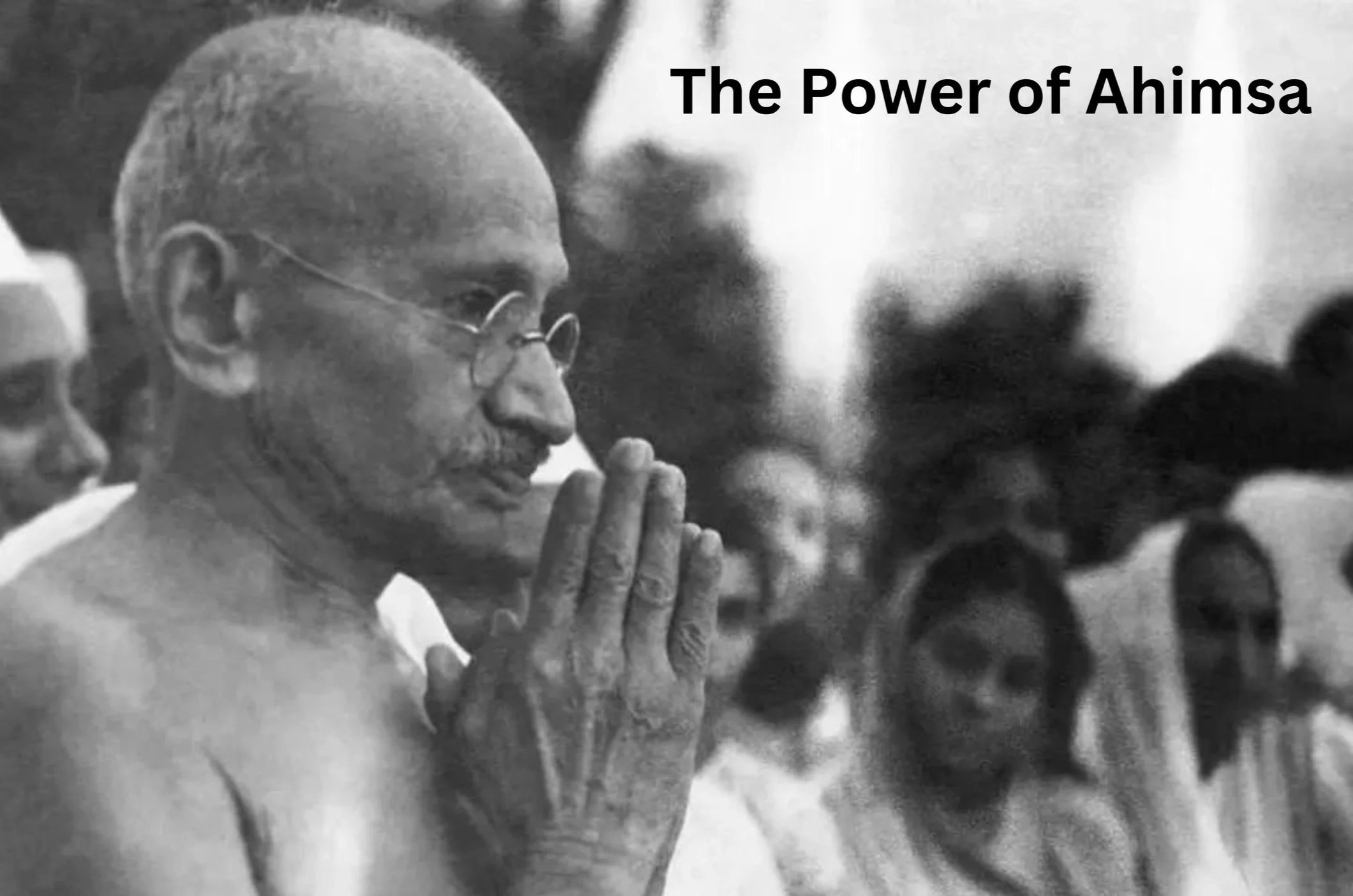
Ahimsa, in its subtle power, depends on a cosmic principle — that of the oneness of life. Ahimsa, in its positive form, means the largest love, the greatest charity. When ahimsa becomes all-embracing it transforms everything it touches. There is no limit to its power. Gandhiji understood that power. He made a conscious and constant effort to apply the power of ahimsa in his daily life. Ahimsa is living so as to realize the oneness of life.
For Mahatma Gandhi, the pursuit of Truth, dedication to the law of love, practice of selfless service, and aspiration for self-liberation, pave the way to unify the human experience. He wanted to awaken minds and unite hearts to a higher ideal—an ideal that unites Truth, love and service into living practice.
All the religions of the world, while they may differ in other respects, unitedly proclaim that nothing lives in this world but Truth.
Consider Gandhiji’s ashram prayer meetings. Through these prayer meetings, an ideal of devotion was practiced on a daily basis. The prayers, hymns, slokas and bhajans offered inspiration to nourish the mind, heart and soul each and every day. The time given to the thought of that Reality which pervades the whole universe, built a foundation of respect and reverence within each and every participant, and perhaps in hearts beyond.
If, therefore, we achieve that purity of the heart, when it is emptied of all but love, if we keep all the chords in proper tune, they ‘trembling pass in music out of sight.’ … Our prayer is a heart-search.
Love is the essence of life. It generates in us a continuous source of power which is indestructible, ever-productive and transforming. In our love, we awaken ourselves to the higher principles of life. Our ideal is to manifest this love in its perfection. The idea of the oneness of life—that you and I are one, that we are one with the stars and the planets. That if I harm you or another, I harm myself.
To slight a human being is to slight those divine powers and thus to harm not only that being but with him the whole world.
One cannot separate one’s love for God or Truth from an all-encompassing love of creation. They are inseparable. This is what Gandhiji tried to express. This is the law of love, of life. Love is more than feeling. It is all-consuming thought and fullness of action. It is absolute oneness.
I believe in the absolute oneness of God and therefore also of humanity. What though we have many bodies, we have but one soul. The rays of the sun are many through refraction. But they have the same source. I cannot, therefore, detach myself from the wickedest soul nor may I be denied the identity with the most virtuous.
Ahimsa, in its subtle power, depends on a cosmic principle — that of the oneness of life.
Ahimsa, in its positive form, means the largest love, the greatest charity. When ahimsa becomes all-embracing it transforms everything it touches. There is no limit to its power.
Gandhiji understood that power. He made a conscious and constant effort to apply the power of ahimsa in his daily life. Ahimsa is living so as to realize the oneness of life.
By Srimati Karuna

Kriya Yoga
In this Kriya Yoga Meditation series we will examine the life and practice of Kriya. Each evening we will explore the abode of PEACE within us by our own personal effort and unfoldment. AUM-SHANTHI



Thread of Desire
When our desires are many, they overwhelm us. We don’t know which one to fulfill, when, or how. Yet, out of this maze of infinite desires, we find the soul’s one true desire: the perfection of absolute oneness.
By Srimati Karuna
When our desires are many, they overwhelm us. We don’t know which one to fulfill, when, or how. Yet, out of this maze of infinite desires, we find the soul’s one true desire: the perfection of absolute oneness.
A yearning develops within us to experience our true self. With this desire, we genuinely long for meditation. At this point, meditation is much more than a habit or a discipline. When we seek the life of meditation with an all-consuming desire, it is like longing for a breath of air while immersed deep in the water. All we desire is that breath.
This single desire becomes like the thread that passes through the eye of a needle. Everything we do becomes stitched with that thread. It transforms every aspect of our life with a single current of thought. In this current of thought, feeling, inspiration, vibration—we are completely absorbed—body, mind, heart and soul. It is a sublime surrender into the depth of our being.
——————————
“Since the beginning of creation, every soul has been endowed with the desire to regain its original state of absolute perfection. This desire inspires the spiritual aspirant to manifest his divinity in its fullest glory.
“Self-illumination is the ideal of meditation. Therefore, do thou practice Kriya with the sole desire for spiritual perfection so that thy physical, mental and spiritual nature may be directed to the realization of the highest good.
“Make thy meditation incessant. Desire not phenomenal powers. Be not misguided nor do thou falter in meditation. The Absolute is within. Keeping thy mind firmly directed to thy highest Self, continue in thy meditation. Let no discouragement overcome thee in thy joy and determination. Meditation always leads to self-realization.”
—Srimad-Bhagavad-Gita: The Revelation of the Self by Swami Premananda

Hamsa
When others around him sank into gloom and despair, Gandhiji held on to an unfailing optimism. A text often on his lips to reawaken others' lost inspiration was from Tulsidas' Ramayana: "All things - with or without life - the Lord has created with their good and bad points. The wise like the discerning swan separate the good milk and reject the adulterating water."
By Srimati Karuna
Hamsa is the Sacred Swan. Many poetic images are derived from the flight of the swan to an abode at Manasarovar Lake in the Himalayas. In the Hamsa Jataka, the swan symbolizes wisdom and loyalty. And the Goddess, Sarasawati, rides the sacred swan that can separate milk from water, a symbol of discernment and detachment. It represents discernment because the sacred swan, if offered a mixture of milk and water, is said to be able to separate milk from the water and drink the milk alone. The swan thus symbolizes the ability to discern the eternal from the ephemeral.
Mahatma Gandhi often repeated the words from Tulsidas’ Ramayana: ”All things - with or without life - the Lord has created with their good and bad points. The wise like the discerning swan separate the good milk and reject the adulterating water.” Beyond the relative knowledge of the mind is the pure consciousness of soul which enlightens our reason, instinct and intuition.
The hamsa also symbolizes detachment because though swans need water for their survival, they can always fly away without a drop of water burdening their wings. The flight of the swan relates to moksha, freedom or liberation. This release from Samsara is represented by its freedom to travel between heaven and earth. This hamsa, a migratory bird, symbolizes the transcendent and is thus identified with the Supreme Spirit or Brahman.
In Sanskrit, Soham or Sohum means “I am That." It is identification with the Ultimate Reality. The mantra is also inverted from so 'ham (saḥ + aham) to ham + sa (“That I am.”) The combination of so ‘haṃ and haṃsa has also been interpreted as "I myself am the Swan.” HAMSA is also HONGSWA.
“The flame of pure-consciousness is eternally ignited within this body. By the meditation of Hong-Swa, all delusion having been dispelled, the Self is revealed in its effulgent glory. In the realization of oneness with Brahman, the Self, man transcends death. There is no path other than this to the attainment of immortality and bliss…The Supreme Self is Hong Swa, which leads to the realization of SOHONG in wisdom and bliss.” (Svetasvatara Upanishad, Ch 6:16 and 3:18)
“O Thou self-manifested cause and substance of creation, O Thou indwelling Self of all, Thou source of illumination, guide me beyond Thy rays of creation, transport me beyond Thy objective form that, by Thy grace, I may behold Thy glorious Self: That absolute Self abiding in the transcendental effulgence, verily, I am That.” (Isha Upanishad, v16)
Patanjali’s Yoga Sutras also refer to viveka or discernment. It is that mental state which is capable of discerning what is true from what is false, what is permanent from what is fleeting, and what brings suffering from what does not. Viveka is considered as the first requirement in the spiritual journey. Vivekachudamani is a text, attributed to Adi Shankaracharya. It means the “crest-jewel of discrimination” and it discusses the viveka, discrimination or discernment, between the Real (unchanging, eternal) and the unreal (changing, temporal) and reflects on the oneness of Atman and Brahman. The next requirement in this journey of Self-Realization is vairagya or detachment. It is a natural extension of viveka. Hence, we come to recognize in the symbol of the HAMSA, realization derived from viveka and vairagya, discernment and detachment.
The swan can tell us the good from the bad
Floating on a pond near a lily pad
As graceful and beautiful as silk
Separating water mixed with milk
The swan will tell us of its role
To reflect freedom of the soul
At home on water and on land
At ease in all ways, small and grand
Of spirit or matter, body or mind
Arise, every one! Awake, every kind!

Gandhi and Advaita
On the occasion of Gandhi Jayanti, the observance of the birth anniversary of Mahatma Gandhi, we reflect upon the enduring inspiration of his idealism.
By Srimati Karuna
On the occasion of Gandhi Jayanti, the observance of the birth anniversary of Mahatma Gandhi, we reflect upon the enduring inspiration of his idealism. This idealism is rooted in his faith in Universal Truth. He said, “I believe in Advaita, in the essential unity of man and for that matter, of all that lives.” His life revolved around his belief “in the oneness of God and, therefore, in the oneness of humanity.” His was a belief in the absolute oneness of all.
Gandhi emphasized that “Truth alone is eternal, everything else is momentary.” And the Vedas record the powerful and significant Advaitist revelation: “Ekam Sat” — “Truth is One.” It is the monistic philosophy that there is one reality which pervades all. Gandhi’s commitment to Truth and Love (Satya and Ahimsa) is rooted in this ideal.
Absolute Monism or Advaita Vedanta is considered a philosophy or spiritual pathway rather than a religion. It cannot be contained nor limited to any one scripture. It is found in all scriptures of self-enlightenment, all revelations of Truth. The word Advaita means non-dual. Veda is the knowledge of wisdom.
The philosophy of Advaita Vedanta is expressed in the subjective teachings of the Upanishads but has also been given moral application through the compassionate example of the Buddha. It found rejuvenation through the intellectual approach of Shankaracharya and Mahatma Gandhi brought new life to Advaita philosophy through his selfless service.
The ideal of Advaita is to realize that one’s true Self is of identical nature with the God of the universe. It is the realization of the relationship of all beings to the one Reality… complete identification with that Reality or Truth. Gandhi believed and often articulated that “God is Truth.” He even turned it around and said: “Truth is God.” For Gandhi, Truth, Love, and God were interchangeable terms.
Advaita is the philosophy of the soul’s realization of perfection. Gandhi’s effort toward Swaraj (“Swa” means Self and “Raj” means Rule — Self-Rule) was not merely aimed at political and economic self-rule for India, but for a universal Swaraj of the individual self. Individual Swaraj or Self-Rule guides the individual toward a mastery of the Self that frees one from all limitation, from the bondage of negativity, fear, and attachment. Gandhi said, “The greatest power in the world is that of the Soul. To attain peace we must first attain greater mastery over ourselves.” His goal was to attain moksha: self-liberation through self-realization. He was a universalist ever seeking the Truth that all human life aspires to reach: True knowledge of the Self. He said, “The purpose of life is undoubtedly to know oneself. We cannot do it unless we learn to identify ourselves with all that lives.”
Mahatma Gandhi utilized the ashram life as a sort of spiritual laboratory. It was the environment he created in which to test and experiment with the ideal of Truth. Just as Henry David Thoreau went to Walden Pond to experiment with the simple life, a life enriched by a natural heritage, Gandhiji, too, explored the domain of the Soul through prayer and service in the ashram setting. His deep conviction in terms of his experiments with Truth reveal that he was constantly engaging the reality and applicability of Truth within the ever changing conditions of life. Through a combination of faith and experience, Gandhi pursued Truth above all else.
We, too, can create an environment in which to search deeply and personally the understanding and application of the philosophy of Advaita. We do this through our own study, service and meditation. We do this as we observe our own spiritual growth, as we become more attuned to the oneness of life.
Although Gandhiji undertook very practical objectives in terms of breaking down societal barriers and advancing constructive programs, he always had at the heart of his life’s ambition, the goal of self-realization. He attempted to live his ideal, Truth. He was committed to his statement that “Truth to be real must incarnate in human life.” Gandhiji lived and worked to reawaken the human heart and mind to a higher ideal — the ideal that unites Truth and Love into a living practice.